Nosferatu (1922)
- siennamason5
- May 26, 2023
- 2 min read
Nosferatu is a 1922 German expressionism horror film based on Bram Stokes's Dracula. The plot essentially mirrors Stokes's book, following Count Orlok who summons Thomas Hutter to his remote Transylvanian castle in the mountains and traps him there. Hutter succeeds at escaping, however, Orlok follows him to his hometown, causing chaos between him, his family and his friends. In the end, Hutter defeats Orlok him melting in the sunlight.
The film stood out with its graphic portrayal of Orlok. Film was new at the time, and so audiences most likely had never seen anything horror related, or as graphic.
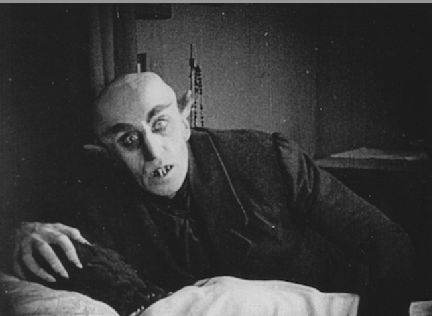
- Long fingernails
- Oversized nose
- fangs hanging out of his mouth
- long ears
Reviewing this film, the initial factor that stood out to me was the characteristics/visuals of German expressionism evident in the film. The film uses chiaroscuro lighting, heavy shadows and distorted shapes- discomforting the viewer and essentially communicating the psychological state of the plot and characters with viewers.

Since watching German expressionism and learning more about them, the design choices are something that has always stood out to me. Thus, I really liked seeing them used in this film and I think it definitely emphasises its place as a horror film.
In this image, for example, I think the use of the technique 'chiaroscuro lighting' effectively emphasises Orlok's features. The high contrast clearly shows his oversized nose and long nails while also adding mystery/horror to his character as you cannot see him in detail.
Aside from the design, another important factor to note is the bad reputation the film developed- focusing on the theme of antisemitism. Unintentionally, the film draws links with medieval conspiracy theories about Jews- and influenced future antisemitic theories. To start, Bram Stokes's book 'Dracula' largely involves anti-semitism which Nosferatu is based upon- with there being characteristics like a hooked nose which is a common Jewish feature for example. Furthermore, referring back to Nosferatu's influence on anti-semitism- the film inspired writing in Hitler's diary 'Mein Kampf' written in 1925, and later on inspired nazi propaganda. Hitler described the Jews as 'blood sucking' and 'that race which shuns the sunlight' for example- and with these both being factors in the film it gives Nosferatu this bad reputation. Additionally, Nosferatu ends with Orlok burning in the sunlight, which Dracula the book does not involve- furthering the influence of anti-semitism in the film.
Overall, I really enjoyed exploring the visuals in this film and I found the horror aspect to draw me into the story (with horror being one of my favourite genres). I also found the controversial aspect of the film to be interesting to explore- I feel like I learnt a lot watching and researching the film, and as a result, the viewing was rewarding.


Comments